
For years the robotic mower had one way of knowing where its lawn ended: a wire. You laid it around the edge, the mower detected it, and that was the boundary. It worked, and for many lawns it still works. But the wire is also the part that people dread about installation, and in recent years manufacturers have introduced mowers that dispense with it.
The new systems are genuinely different, and each has strengths and weaknesses that depend on your yard. Here is how they compare.
Short answer: choose a boundary wire if you have mature trees or want the most predictable behaviour for the least money. Choose a satellite or vision system if your lawn has open sky and you dislike the idea of digging.
Boundary wire
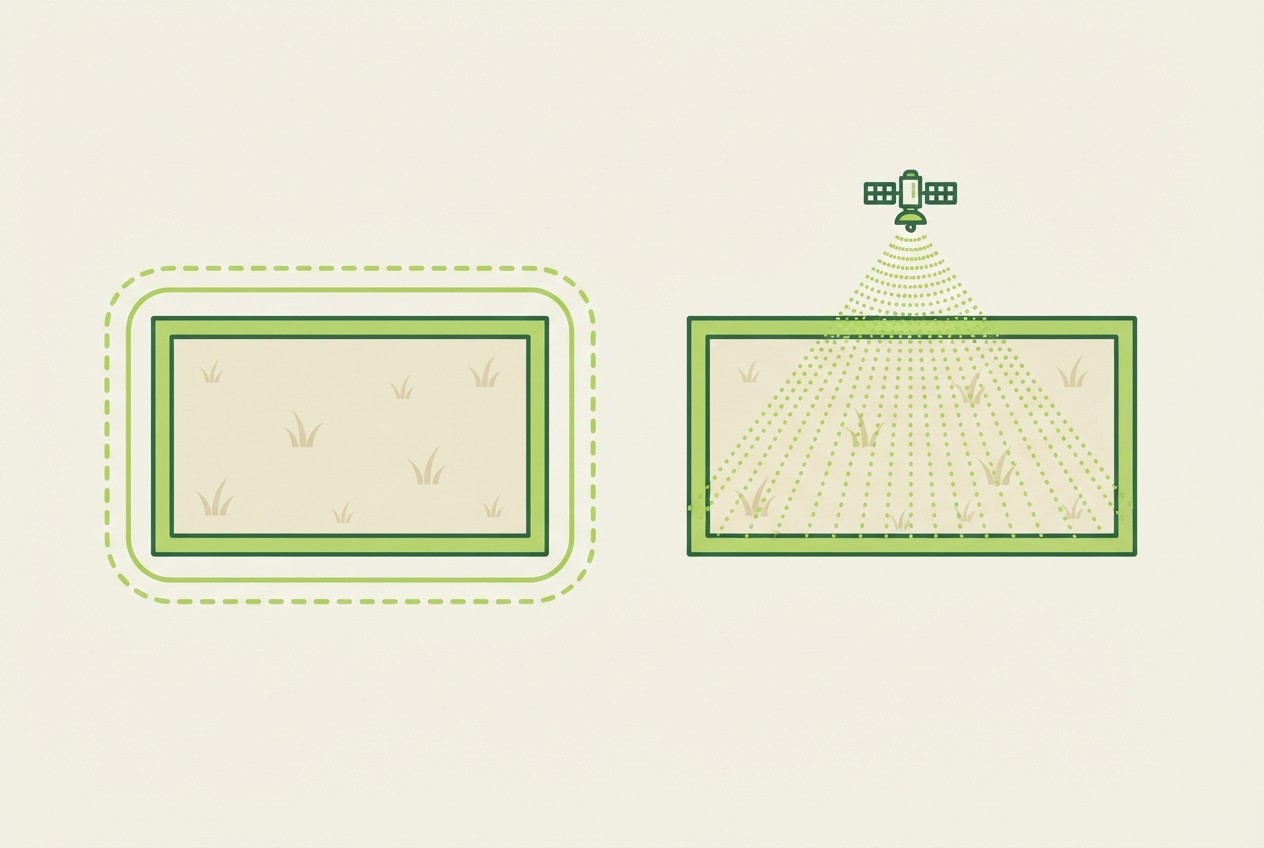
A thin, low-voltage cable runs around the lawn’s perimeter and around any area the mower must avoid, such as a flower bed, a pond or a tree. The charging station sends a small signal along it, and the mower senses that signal. When it reaches the wire it turns. Guide wires, a second kind of cable, can help the mower find its way home or reach a distant part of the lawn.
Strengths. It is robust. The wire does not depend on satellites, cameras or lighting, so it works under dense trees, beside tall buildings, in shade and at night. It is the most predictable method: where the wire is, the boundary is. It is also the least expensive technology, which is why entry-level machines use it.
Weaknesses. Installation takes time and care, and mistakes in placement show up as strange behaviour. The wire can be damaged by edging, aeration, digging or a stray spade, and finding a break in a buried cable can be frustrating. Changing the lawn, for example by adding a new bed, means moving the wire. And the wire has to be connected correctly, with proper waterproof connectors, or it fails slowly as moisture gets in.
Satellite positioning, including RTK
These mowers determine their position using satellite signals, the same technology your phone uses, but with much greater accuracy. Ordinary satellite positioning is accurate to a few feet, which is not enough to keep a mower off a flower bed. To improve on it, many wire-free mowers use a technique called real-time kinematic positioning, abbreviated RTK, in which a fixed reference station at a known location corrects the mower’s readings, bringing accuracy down to a very small distance.
The reference station may be a small antenna mounted on a pole or roof at your property. Some systems instead use a network of correction data over a mobile connection, which may involve a subscription.
Strengths. No wire to bury. You draw the boundary on a map in an app, and changing it is a matter of redrawing. Zones, no-go areas and schedules are managed on a phone, and systematic mowing patterns are possible.
Weaknesses. It needs a clear view of the sky. Mature trees overhead block or distort satellite signals, and tall buildings reflect them, so parts of a yard under a canopy may be difficult. Performance can vary with weather and the satellite geometry at a given moment. The reference antenna has to be installed in an open location, which is itself a small project, and the machine and system tend to cost more.
Vision-based systems
Some newer mowers use cameras and software to recognise the edge of the lawn, to tell grass from paving or planting, and to spot obstacles. Many combine vision with other sensors, and some with satellite positioning, to produce a boundary without any wire.
Strengths. They can adapt to a lawn without a buried boundary, and they can recognise obstacles that a wire would never know about, like a toy or a garden chair.
Weaknesses. They depend on lighting and on the camera seeing clearly. Low light, glare, heavy shade or dirt on the lens can degrade performance. The software is still developing, and behaviour can change with updates. As with any new technology, expect improvements and some rough edges.
Beacon-based systems
A few mowers rely on a set of small posts or anchors placed around the yard that communicate with the mower using radio signals, allowing it to calculate its location from their positions. They avoid the need for a clear sky, which helps under trees, but the beacons have to be positioned correctly and kept in place, and they add parts to the yard.
The four systems compared
- Setup effort. Boundary wire: High: lay and connect cable. Satellite or RTK: Moderate: place antenna, draw map. Vision: Low to moderate. Beacon: Moderate: place posts.
- Under tree cover. Boundary wire: Works. Satellite or RTK: Can struggle. Vision: Depends on light. Beacon: Works.
- Changing the lawn. Boundary wire: Reposition the wire. Satellite or RTK: Redraw in the app. Vision: Redraw in the app. Beacon: Reposition posts or redraw.
- Damage risk. Boundary wire: Wire can be cut. Satellite or RTK: Antenna blockage. Vision: Lens dirt, poor light. Beacon: Posts knocked over.
- Depends on. Boundary wire: Intact wire. Satellite or RTK: Open sky. Vision: Good visibility. Beacon: Beacons in place.
- Relative cost. Boundary wire: Lowest. Satellite or RTK: Higher. Vision: Higher. Beacon: Middle to higher.
Choosing by your yard
- A yard with big mature trees. The wire, or a beacon-based system, is generally the safer choice. Satellite signal under heavy canopy is the commonest reason a wire-free mower misbehaves.
- An open lawn with a clear view of the sky. Satellite-based mowers are likely to work well, and the convenience of drawing a boundary in an app is substantial.
- A lawn that changes often. Wire-free systems make it easy to reshape the boundary. If you keep adding beds or changing the garden, avoid being tied to buried cable.
- Complex shapes with several separate areas. Both can handle them, but check how each machine manages transport between areas.
- A tight budget. A wired machine delivers the most capability per dollar.
- You hate the idea of digging. That is the honest case for wire-free, and it is a perfectly good reason.
Hybrids and the direction of travel
Manufacturers increasingly combine methods: satellite positioning with sensors for obstacles, vision with a wire in difficult spots, or a wire for the perimeter and sensors for everything else. This reflects the fact that no single method is best everywhere. A mower that can fall back on a second source of information when the first fails is more robust than one that relies on a single signal.
The technology is changing quickly. A recommendation written today may be out of date within a couple of years, so check current reviews and the manufacturer’s specification, and ask a dealer how the machine behaves on a yard like yours.
Questions to ask before you buy
- How does this mower handle tree cover, and what happens when positioning is lost?
- Does it need a reference antenna or a subscription for correction data, and what does that cost over time?
- How does it behave at night, or in low light?
- What happens if the signal is lost midway through a cut?
- If it uses a wire, how is the wire supplied and what do the manufacturer’s instructions say about laying it?
- How do updates change the machine, and what is the support policy?
- What is the warranty, and does it cover wire damage or antenna problems?
The wire is not obsolete, and the wire-free systems are not a gimmick. Look at your trees, your sky and your patience for installation, and let those decide.
Which system for which yard
- Big mature trees overhead: a wire, or a beacon-based system.
- Open lawn with no canopy, and a garden that keeps changing: satellite or RTK, where the boundary is redrawn in an app.
- A tight budget: a wired machine gives the most capability per dollar.
- A complicated shape with several zones: check how the machine moves between zones, whichever technology you pick.